
The N8 PRP Policing Innovation Forum 2026
Policing, People and Health
16 June 2026 | Newcastle
Researchers, policing professionals, healthcare practitioners and third-sector partners came together at Newcastle University on 16 June for the tenth annual N8 PRP Policing Innovation Forum.
Hosted by the N8 Policing Research Partnership (N8 PRP) in collaboration with the Scottish Institute for Policing Research (SiPR), this year’s forum explored the theme Policing, People and Health, examining how policing and health services can work together to respond to vulnerability, reduce harm and improve outcomes for the people they support.
Across keynote, panel and roundtable sessions, delegates explored emerging evidence, practical interventions and opportunities to strengthen collaboration between research, policy and frontline practice.
Sharing responsibility for complex challenges

Gary Ritchie, Keynote Speaker
The day opened with a keynote from Gary Ritchie, retired Assistant Chief Constable of Police Scotland and Chair of the International Committee at SiPR. Addressing the growing overlap between policing and public health challenges, the keynote argued that issues such as mental ill-health, addiction, exploitation and inequality require collaborative responses across organisational boundaries rather than isolated solutions.
The keynote set the tone for the day, highlighting the importance of sustained partnership working and encouraging delegates to consider how policing, health and community services can work together more effectively to support vulnerable individuals.
Community wellbeing and harm reduction

Professor Fiona Measham
The morning’s first panel explored preventative and harm reduction approaches to policing and community wellbeing.
Presentations examined a range of initiatives and research, including public-health approaches to policing in Scotland, the development of drug checking services, police-led drug diversion schemes and the challenges of embedding evidence-based preventative approaches within policing practice. Speakers shared insights into emerging models designed to reduce harm, improve outcomes and support individuals away from criminalisation and towards appropriate services and support.
Discussions highlighted both the opportunities and challenges involved in delivering wellbeing-focused policing, including the importance of multi-agency collaboration, consistent implementation and strong links between policy, evidence and practice.
Interagency working in custody

Dr Gethin Rees
The second panel focused on collaboration within police custody settings and the ways in which organisations can work together to support people experiencing vulnerability.
Presentations explored healthcare provision in police custody, responses to mental health crises, trauma-informed approaches and support for children and young people affected by family justice involvement. Speakers discussed the importance of effective partnership working, safeguarding and shared responsibility in improving outcomes for people who encounter the criminal justice system.
The session highlighted the complexity of supporting vulnerable individuals in custody environments and reinforced the need for coordinated approaches that bring together policing, healthcare and wider support services.
Innovation in Action
Following a stakeholder roundtable featuring contributors from healthcare, policing, the third sector and industry, delegates participated in a series of Innovation in Action roundtables. These sessions showcased ongoing and recently completed research projects and encouraged discussion around practical application and future collaboration.
Topics included suicide prevention among people accused of sexual offences, the experiences of autistic people during arrest and custody, transfer of care for individuals experiencing mental health crises, and research exploring the experiences of young people in police custody in Australia.
The roundtable format provided opportunities for delegates to engage directly with researchers, exchange ideas and consider how research findings can be translated into practice across policing and health settings.
Supporting the next generation of researchers
The forum also featured an Early Career Researcher (ECR) and Postgraduate Researcher (PGR) poster exhibition, sponsored by Routledge, providing an opportunity for emerging researchers to share their work and engage with practitioners and academics from across the sector.
This year’s poster competition was jointly won by two Newcastle University researchers:
- Matthew Ryding for Interprofessional Collaboration and Hate Crime Reporting
- Sarah Connelly for What meaning does the concept of vulnerability hold for professionals working with vulnerable adults in police custody?
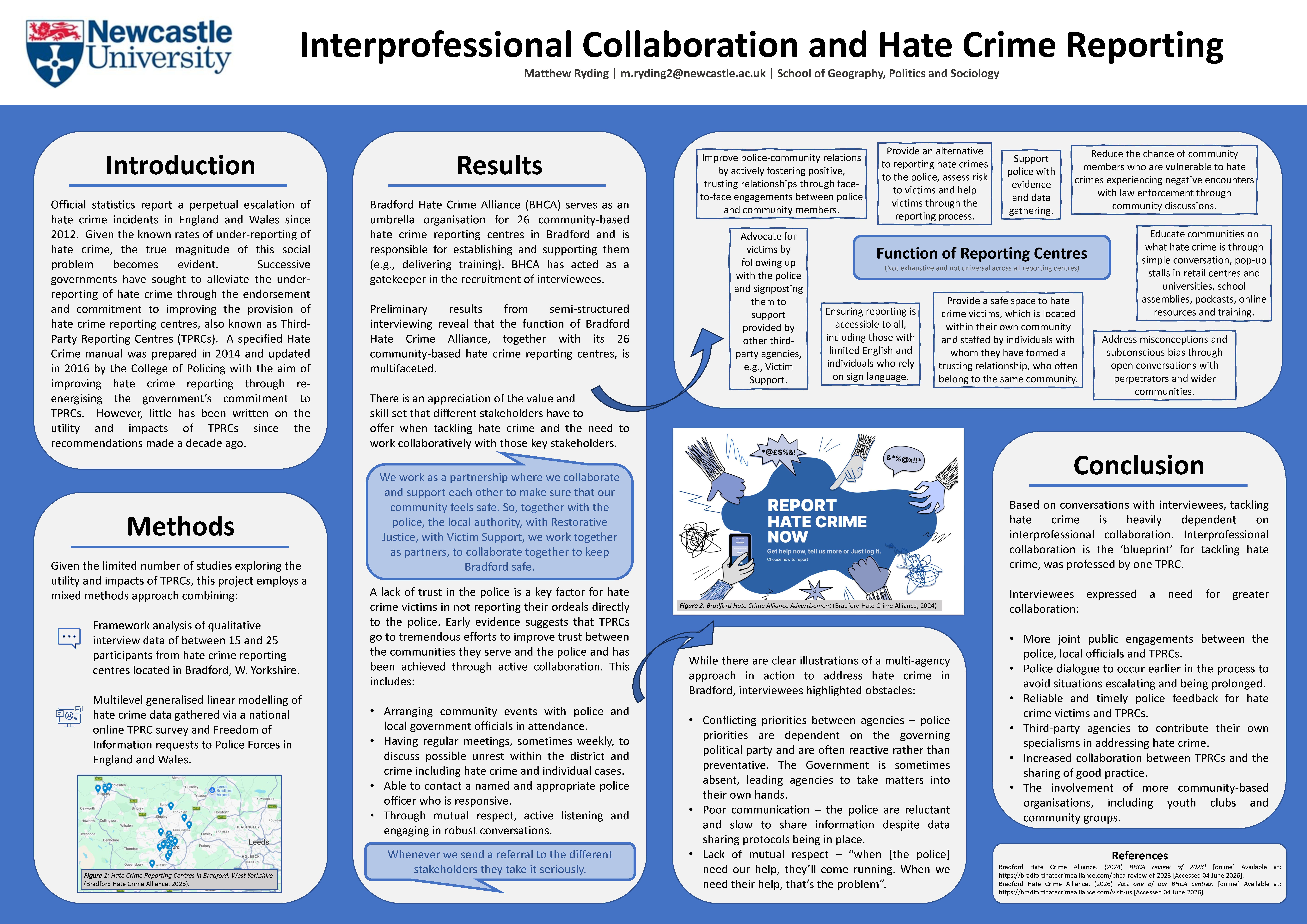
Matthew Ryding
Interprofessional Collaboration and Hate Crime Reporting – Matthew Ryding, Newcastle University
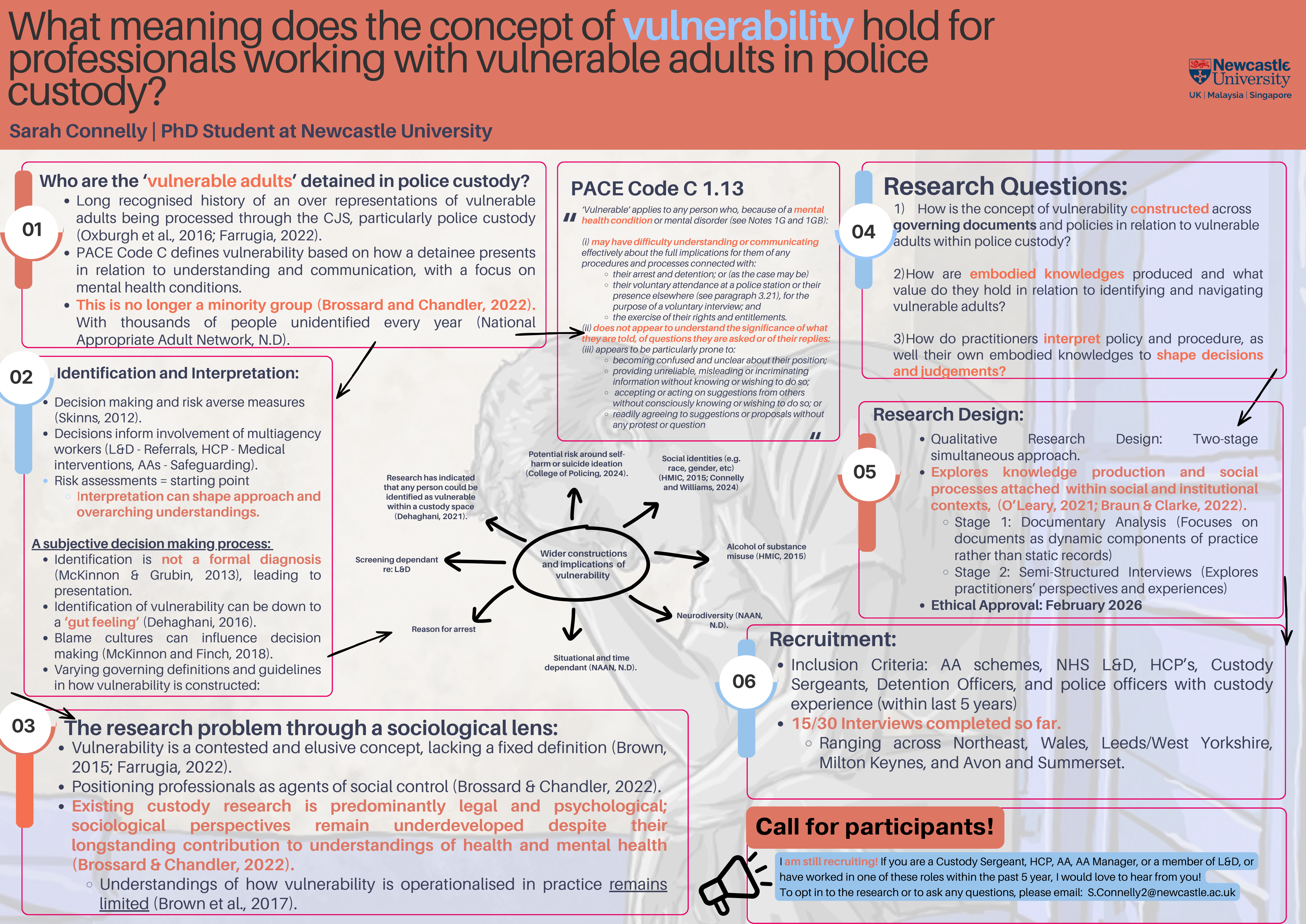
Sarah Connelly
What meaning does the concept of vulnerability hold for professionals working with vulnerable adults in police custody? – Sarah Connelly, Newcastle University
“I really enjoyed the event and the opportunity to present my work as an ECR, but also to engage in discussions with both academics and professionals around the trajectory of my PhD and future work.”
Sarah Connelly, Lecturer in Criminology and Manager of the Northumbria Local Appropriate Adult Scheme (NLAAS), University of Sunderland
Turning evidence into action

Jason Kew and delegates
The 2026 Policing Innovation Forum demonstrated the value of bringing together researchers, practitioners and policymakers to address challenges at the intersection of policing and health. Through evidence sharing, discussion and collaboration, delegates explored new ideas, strengthened partnerships and identified opportunities for future research and innovation.
“It’s possible to bring about the most complex and tricky of policy changes when you have the right people in the room. The N8 PRP event brought together academics, lived expertise, NGOs and policing to hear the latest in research and evidence, while learning about gaps in the system. And crucially, the platform has now been created to bring positive change across the whole justice and health system.”
Jason Kew, Honorary Member of the Faculty of Public Health Drugs Special Interest Group and Visiting Fellow at the University of South Wales Substance Use Research Group
Policing, People and Health
Policing, People and Health